
| 1_ |
NTSC:
Introduction |
| 2_ |
Scanning,
Timing/Sync, Sync Recovery, Numbers |
| 3_ |
Gain
& Offset, D.C. Restoration, Gamma Correction |
| 4_ |
Resolution, Bandwidth, Spectrum |
| 5_ |
Color
Physics: Eye, CIE |
| 6_ |
Color
Encoding: Color Bars, Camera,
RGB,
YIQ, Color Subcarrier |
| 7_ |
Color
Decoding: |
| 8_ |
Digital
TV/Graphics: ADC-DAC, Frame Buffers, Timebase Correction, VGA |
| 9_ |
VCR:
Spectrum, Circuits |
| 10_ |
Circuits
& Practices: D.C. Restore, Proc Amps, DAs |
|
|
|

Resolution Test Pattern
|

|
 |
 |
 |
 |
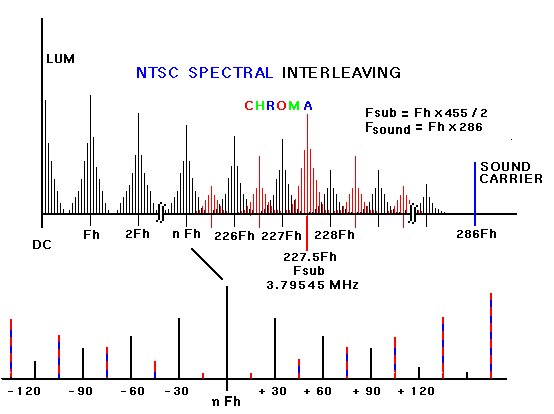
| Mix of NTSC band-limited signals as seen at the transmitter output:
the Luminance is AM VSB, the Chroma is DSB I&Q, and the Aural FM. |
|
|
Television-For-EEs
Television
Technology for Engineers, Technicians & Hobbyists
| Television
encompasses more subject areas than any other single technology. You learn
switching power supplies, perception, wireless communications, ergonomics,
physics: --the list is endless... |
|
|
|
|
"TV Lines" Resolution Wedges
undergo band limiting
|
 |
|
Resolution > 800 TV Lines
|
| |

|
|
Resolution ~ 650 TV Lines
|
| |

|
|
Resolution ~ 530 TV Lines
|
|
| Animation
Demonstrating the Kell Factor |

|
| The Kell Factor is the effect when a finite
round scanning beam encounters an abrupt transition, e.g., from black to
white.
If, however, the scanning beam were infinitely small or rectangular,
then the transition would produce a step function. |
|
|
|
|
|
|

